
Popcorn weed is pea- to marble-sized cannabis flower from the lower or inner branches of the same plant, not a separate strain or a fixed potency class. The popular advice that small buds are always weaker confuses what a flower looks like with what a laboratory measures.
That confusion can cost you in either direction. You might dismiss a suitable flower because it isn’t impressive in the jar, or assume a discounted bag matches a premium option without checking its label. A better approach separates plant position, retail sorting, and measured potency.
What Popcorn Weed Is
Popcorn weed, also called popcorn buds, popcorn nugs, or smalls, is ordinary cannabis flower that stayed small. The name describes its rounded, popped-kernel appearance, not a popcorn flavor, a genetic family, or a special processing method.
Look for individual flowers with a recognizable bud structure, like the pieces shown below.
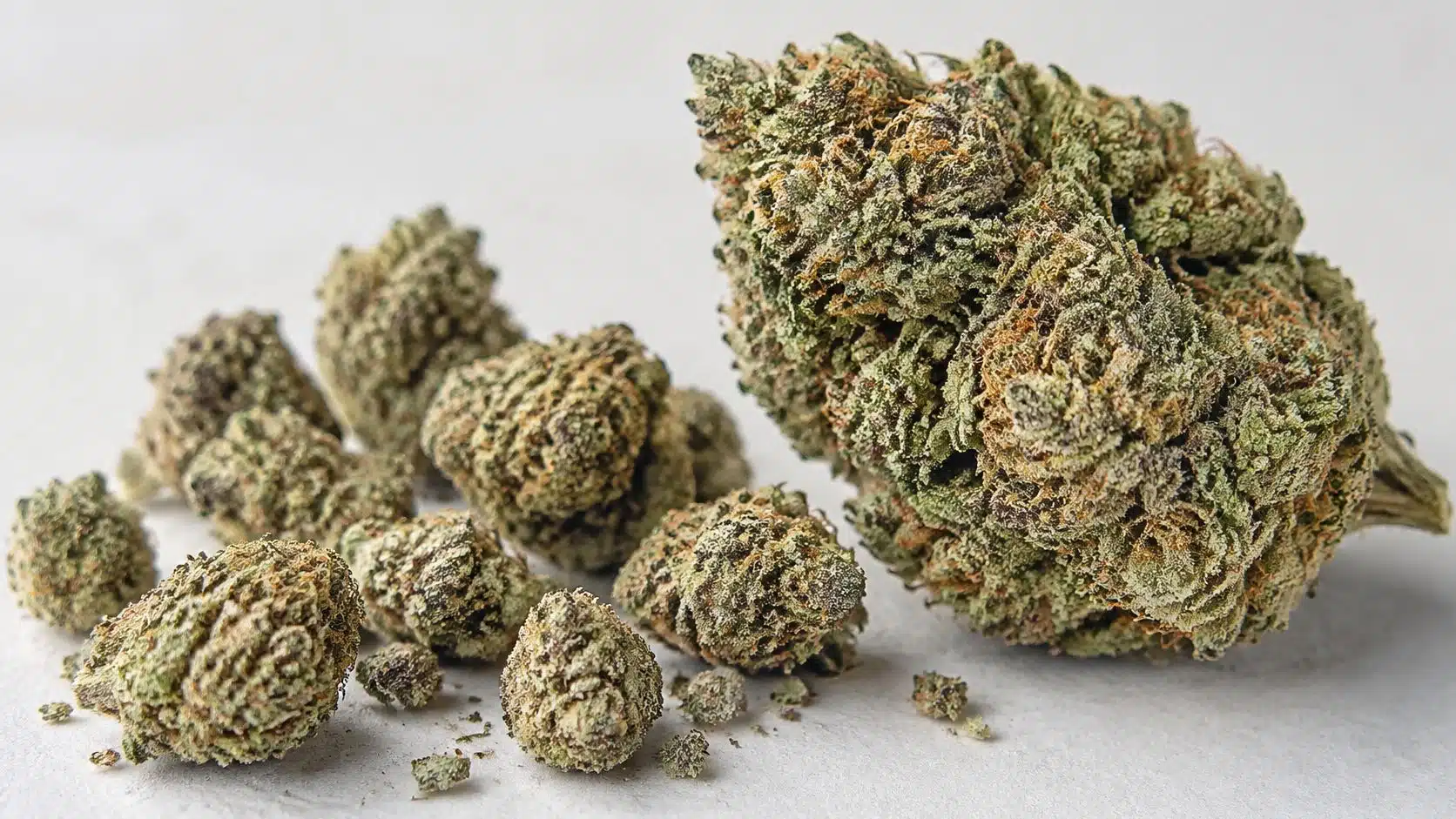
Say a cultivator harvests a cannabis plant with prominent flowers at its upper tips and smaller flowers tucked inside its branches. After drying and curing, the larger pieces may go into a premium whole-flower package, while the smaller intact pieces get sorted into a smalls package. The cultivator hasn’t created another strain by separating them.
Think of a tomato plant with large fruit on its sunny side and smaller fruit deeper in the foliage. Both are tomatoes from the same plant, even though they don’t look identical. The analogy explains the size difference, but it doesn’t promise identical chemistry in every cannabis flower.
Small doesn’t mean unfinished
A flower can reach harvest maturity without becoming a large, dense cola. Calling every small bud immature confuses how much it grew with how far it progressed through flowering.
Popcorn generally goes through the same basic harvesting, drying, curing, and packaging processes as larger flower from its crop. It isn’t automatically a leftover product, and it hasn’t necessarily been stripped of anything.
The video below offers another visual reference.
Start with the right distinction: A small whole flower is still whole flower. Its dimensions don’t tell you its laboratory result.
When someone asks, “What is popcorn weed?” the useful answer begins with the physical product. Whether that product is strong, fresh, or good value requires information that the nickname alone can’t supply.
Popcorn Bud Size Next to Other Flower Grades
| Grade | Typical size | Where it grew | Usual look | What the name claims |
|---|---|---|---|---|
| Top cola or A buds | Thumb-sized or larger | Main top of the plant | Dense, uniform, showy | Premium presentation, not a potency guarantee |
| Mids | Between marble and thumb | Upper and mid canopy | Solid but less perfect | Mid-tier whole flower |
| Popcorn buds or smalls | Pea to marble | Lower or inner branches | Rounder, often airier | Size and sorting class only |
| Shake or trim | Fragments, not whole nugs | Shake breaks off during handling; trim is removed during manicuring | Loose flower bits, leaf, or a mixture | Not the same product as intact popcorn |
These are shopping descriptions, not standardized laboratory grades. In its popcorn buds and smalls guide, Barney’s Farm describes popcorn as small flowers associated with lower or inner plant positions, rather than a distinct strain or chemical category.
The table gives you a vocabulary for comparing packages, but it isn’t a ruler every producer follows. A retailer’s premium designation can reflect appearance, and its mids category may describe a broader quality tier rather than a tightly defined piece size. Don’t assume two brands sort flower identically.
Popcorn versus shake is the important boundary
Popcorn consists of intact small flowers. Shake consists of detached material. Trim is different again: it’s material removed while manicuring flower, including small leaves around the buds.
Retail menus sometimes group shake and trim together, but that doesn’t make them interchangeable. A bag of loose flower fragments and a bag containing substantial leaf can prepare differently, even if both look less tidy than whole buds.
Use a simple visual check:
- Countable rounded pieces: These fit the ordinary meaning of intact smalls.
- Pourable loose fragments: These fit shake more closely.
- Obvious leaf material: Ask whether the product contains trim rather than assuming it’s all flower.
A Blue Dream package labeled popcorn is still being sold as Blue Dream. The additional word tells you about the pieces, not a new genetic identity.
Sorting labels need a plain-language explanation
Some sellers use popcorn and smalls interchangeably. Others reserve popcorn for their smallest intact flowers and use smalls for a broader assortment.
A separate smalls package may have its own menu entry, while another producer may use small flowers as an ingredient in ground products. Neither practice tells you the package’s strength.
Before comparing prices, establish what you’re buying: intact buds, broken flower, or a leaf-containing mixture. Appearance class answers the format question. It doesn’t answer the chemistry question.
Why Lower Branches Stay Small
Stand beneath a thick patio umbrella and compare the light at its edge with the shade near its center. A cannabis canopy creates a similar contrast: exposed upper growth receives more light, while leaves and branches shade sites farther down and inside.
Plants use light to support growth. Upper leaves and flowers intercept more photosynthetically active radiation, the light plants can use for photosynthesis, leaving shaded flowering sites with less opportunity to accumulate biomass. Kind Seed’s explanation of popcorn cannabis buds identifies uneven light distribution as a primary reason lower flowers remain smaller and looser.
Dense foliage can deepen that shade. Closely packed plants can also restrict light penetration and air movement, so the growing environment around a lower flower may differ from the environment around an exposed top.
Canopy management changes the outcome
Growers can change how evenly light reaches flowering sites. Where cultivation is lawful, common canopy-management approaches include:
- Topping: Changing the plant’s branching pattern instead of allowing a dominant central tip to remain unchecked.
- Trellising and branch positioning: Spreading growth so flowers aren’t crowded beneath one another.
- Selective defoliation: Carefully removing obstructing leaves rather than stripping foliage indiscriminately.
- More even lighting: Reducing the contrast between exposed upper flowers and shaded lower sites.
These practices don’t guarantee identical flowers. They explain why packages carrying the same size label may originate from very different growing conditions.
A loose flower isn’t evidence that someone damaged it after harvest. Its structure may reflect the environment in which it formed, along with the cultivar’s natural growth pattern.
Plant position helps explain flower structure. It doesn’t assign a THC percentage, a terpene amount, or a contamination status.
Genetics, harvest maturity, drying, and curing still influence the finished product. A poorly cured large flower doesn’t become well handled because it’s attractive, and a carefully handled small flower doesn’t become defective because it’s airy.
The important distinction is between a mechanism that can influence chemistry and a measurement of the flower in front of you. Uneven growing conditions can produce substantial chemical differences, while a more uniform canopy may produce much smaller differences.
When Small Buds Are Weaker and When They Are Not
Retire the rule that popcorn is automatically weak. There’s no fixed THC percentage that defines popcorn weed, and the available examples don’t support a universal size-to-potency rule.
The flower-grades explainer from This Is Why I’m High summarizes the contrasting cultivation findings and the broader flower-pricing analysis below.
| Evidence | What was compared | Reported result | Shopper takeaway |
|---|---|---|---|
| 2022 CBD-rich medical cultivar study | Lower axillary flowers versus top flowers | Cannabinoid concentrations up to 90% lower in lower flowers | Position and light can matter substantially in a particular cultivar and growing setup |
| Blue Dream commercial greenhouse summary | Top versus bottom under relatively uniform lighting | Average THC 17.2%, with no meaningful top-versus-bottom potency difference | Small size doesn’t necessarily indicate lower THC |
| Analysis of 710,588 flower listings from 3,693 dispensaries across 30 U.S. states and Washington, D.C. | Price versus reported THC across cannabis flower generally | THC price elasticity 0.17; a 10% increase in reported THC was associated with approximately 1.7% higher price per gram | Reported potency is associated with price, but this wasn’t a popcorn-specific comparison |
Why the cultivation findings aren’t contradictory advice
The studies compared different plants and conditions. The CBD-rich cultivar finding concerns cannabinoid concentrations in that setting, not a universal THC penalty for every small flower.
Likewise, the Blue Dream finding doesn’t establish that all lower flowers match upper flowers. It shows that a meaningful top-to-bottom difference wasn’t inevitable under relatively uniform lighting.
The correct conclusion isn’t that popcorn is always weaker or always equivalent. It’s that you can’t transfer a finding from one cultivar and growing system to every retail jar.
The pricing analysis answers a separate question. It describes an association between reported THC and flower prices, not proof that higher-priced flower is better or that bud diameter caused a price difference. It also doesn’t establish that appearance, aroma, and handling quality are captured by a THC number.
Compare the actual packages
Read the printed THC and CBD information on the smalls package, then compare it with the larger-flower option. Match the cultivar and producer where possible, and check whether the products represent comparable harvests rather than assuming a shared strain name means a shared batch.
A certificate of analysis, often shortened to COA, can provide the batch’s test information. Make sure it matches the product you’re considering, not a different package with a similar name.
For an in-person comparison at our Ballston Spa cannabis dispensary, our team can explain cannabinoid information and strain characteristics without treating size as a scientific measurement.
The laboratory label is the strength check. The intact bud is the size check.
Neither replaces a separate inspection for freshness, moisture condition, and visible signs of spoilage.
Myths That Confuse Popcorn With Bad Weed
Popcorn is its own strain
False. A size label doesn’t identify genetics. Check the cultivar name separately from the format description, just as you’d distinguish a product’s variety from its packaging.
If a menu says only popcorn flower, you still need the cultivar and package information to know what you’re considering. Terpene information may help describe aroma and flavor, but it isn’t proof of strength.
Small means outdoor, stressed, or waste
False. Small flowers can occur in indoor and greenhouse cultivation too. Their size doesn’t show whether the plant experienced stress or whether the finished flower was handled properly.
The better check is product identity: does the package contain intact flower, detached shake, or trimmed leaf? Calling all less-impressive material waste hides differences that matter to the buyer.
Don’t diagnose a grow from a nug: A small flower doesn’t reveal its entire cultivation history.
Cheap means contaminated
False. A discount isn’t a contamination test, and a premium price isn’t a safety certificate. Flower size neither causes contamination nor rules it out.
Look for regulated labeling and relevant batch testing. Skip flower with suspicious fuzzy growth or a damp, musty smell; don’t assume grinding will make questionable material acceptable.
Bigger buds get you higher by weight
False. When you compare equal weights, cannabinoid concentration is more relevant than the size of the original pieces. How much you use and how you consume it also matter, so appearance can’t predict the resulting experience.
Replace the biggest-nug test with a package comparison. Judge the jar by cultivar, laboratory information, freshness, and cleanliness, then treat size as a price and preference factor.
Why Smalls Cost Less and How to Buy Them
Large, uniform colas photograph well and create the presentation buyers associate with premium flower. Cultivators and retailers can charge for that appearance, while smaller flowers may be discounted because they’re less visually striking or require different trimming and sorting.
That doesn’t make every smalls package a bargain. The discount becomes useful only when the flower’s condition, labeled composition, and intended use suit you.
Choose for what you’ll actually do with the flower
If you grind flower before preparing it, paying extra for a large, sculptural bud may offer little practical benefit. A small package with suitable cannabinoid information and good freshness may fit that routine.
Someone who enjoys selecting and handling an intact cola may reasonably prefer larger pieces. They’re paying partly for structure and presentation, not necessarily stronger flower.
Producers may also use smalls in prerolls because the original piece size disappears after grinding. The important question becomes what went into the product and whether the finished batch meets the applicable testing requirements, not whether the input flowers looked impressive.
Follow a package-first buying sequence
For adults 21 and older, use these checks before choosing:
- Confirm the format. Establish that the menu’s smalls label means intact flowers, not shake or a trim-containing mixture.
- Compare the package labels. Read THC and CBD information on the actual options available. Don’t substitute a strain’s general reputation for its current batch results.
- Inspect condition where permitted. Look for excess stem, suspicious growth, and a fresh aroma rather than something damp or musty. Smell alone can’t certify safety.
- Match the purchase to preparation. If you’ll grind everything, give composition, condition, and price more weight than visual density.
- Buy through a licensed retailer and store carefully. Keep the flower sealed, away from heat and light, and out of reach of children and pets.
Small, airy pieces can lose moisture readily in a poorly sealed container. Check what you’re receiving rather than assuming a crowded jar contains little stem, and avoid crushing flower while inspecting it.
You can review available formats through our online store before visiting. At Lucky Dog 420, our team researches terpene profiles, cannabinoid interactions, and strain characteristics to help explain the differences behind product labels.
We’re located at 974 NY-67 in Ballston Spa, operated by Central Apothecary LLC, and hold OCM license OCM-CAURD-24-000072. Products are for use only by adults 21 years of age and older.
If cannabis use feels like a problem, contact the NYS HOPE Line by texting HopeNY, calling (877) 8-HOPENY, or visiting the NYS HOPE Line support page.
At Lucky Dog 420, we combine a curated cannabis selection with science-based education to help you distinguish flower format from labeled potency. Visit our Ballston Spa store with questions about popcorn, smalls, and whole flower, and ask our team to help you compare package information before you choose.